
When churches talk about security, the conversation often begins at the front door. We talk about access control, children’s ministry, cameras, medical response, safety teams, sanctuary procedures, and what to do if an armed attacker enters the building. Those conversations matter, but they can create a dangerous blind spot if we fail to look beyond the doors.
A threat does not suddenly become a threat when it enters the sanctuary. Sometimes the first warning is a vehicle. Sometimes it is unusual behavior in a parking lot. Sometimes it is someone sitting where they normally would not sit, moving differently than normal traffic, attempting unusual access, or doing something that simply does not fit the environment. And sometimes the parking lot itself becomes part of the attack.
Four incidents from 2025 and 2026 illustrate why church parking lot safety and security should be part of every church’s overall safety plan.
The Parking Lot Is More Than a Place to Park Cars
I spent 15 years in law enforcement, including five years as a SWAT commander. One principle from that experience translates directly into church safety:
Early recognition creates time, and time creates options.
That does not mean church parking volunteers should become amateur police officers. It does not mean every unfamiliar vehicle is suspicious or every unusual person should be confronted. It means the people positioned outside the building have an opportunity that many people inside do not. They can see what is coming.
Recent incidents demonstrate just how important that can be.
CrossPointe Community Church: The Warning Came Before the Gunfire
On June 22, 2025, more than 100 people were gathered for worship at CrossPointe Community Church in Wayne, Michigan. Children from vacation Bible school were participating in the service.
Church deacon Richard Pryor arrived late and noticed a man driving recklessly in the church parking lot. That detail deserves attention because the first observable warning was not gunfire. It was abnormal vehicle behavior.
The man, later identified as 31-year-old Brian Browning, exited his vehicle wearing a tactical vest and carrying a rifle and handgun. Pryor was already speaking with a 911 dispatcher while the situation unfolded.
As the armed man continued toward the church, Pryor made an extraordinary decision. He used his Ford F-150 to strike the attacker.
“I’m just realizing there’s no time,” Pryor later told the Associated Press.
The attacker fired repeatedly into Pryor’s truck and continued toward the church. One church security team member was wounded in the leg before other security personnel fatally shot the attacker. More than 100 people were inside the building (Associated Press, “Deacon Hailed”).
Pryor’s decision to use his truck against an armed attacker was an extraordinary response to an immediate threat. It should not be interpreted as a general tactic for parking team members. The lesson I want churches to notice happened earlier.
Someone outside was paying attention.
Something did not fit the normal environment, and it got his attention before the attacker reached the congregation.
Grand Blanc Township: When the Vehicle Became Part of the Attack
On September 28, 2025, hundreds of worshippers were gathered inside a Church of Jesus Christ of Latter-day Saints meetinghouse in Grand Blanc Township, Michigan.
The attacker drove a pickup truck into the building, exited the vehicle, opened fire on worshippers, and set the church on fire. Four victims were killed. The FBI initially reported eight injured victims, although later reporting indicated a ninth person was ultimately classified as injured. The attacker was killed by responding police (Federal Bureau of Investigation, “Grand Blanc”).
This incident presents a different parking lot safety lesson. Most parking teams naturally think about vehicles as a traffic problem.
Where do we park them? How do we prevent congestion? How do we protect pedestrians? How do we keep vehicles from blocking fire lanes?
Those questions are important. But the Grand Blanc attack demonstrated another reality:
A vehicle can itself become part of an attack.
That should cause churches to look differently at the exterior of their properties.
Can a vehicle travel directly from a roadway toward a crowded entrance? Where do children gather during drop-off? Where are people most concentrated before and after services? Could traffic flow, landscaping, positioning, or appropriately designed barriers reduce vulnerability without making the church feel like a fortress?
The answer will be different for every property. The important thing is that someone asks the questions before an emergency occurs.
High Point, North Carolina: Someone Saw Something Before Anyone Was Hurt
The June 28, 2026 incident at Wesley Memorial Church in High Point, North Carolina, provides perhaps the clearest example of what early recognition can accomplish.
At approximately 10:15 on a Sunday morning, someone called 911 about an armed man wearing camouflage sitting in a truck in the church parking lot.
An off-duty police officer working at the church responded, with additional officers arriving within minutes. Police arrested 44-year-old William Milliken III without incident.
According to police and court records reported by the Charlotte Observer, investigators found two flamethrowers, two crossbows, more than 500 rounds of ammunition, three knives, a CO2-powered launcher designed to resemble a handgun, and other items in the vehicle. Milliken was reportedly wearing body armor. Court documents also referenced a notebook containing addresses of churches, schools, and public buildings. Authorities had not publicly established a motive at the time of the reporting (Aldridge).
The most important statistic from this incident is simple:
Zero people were injured.
High Point Police Chief Curtis Cheeks III credited both responding officers and the people who recognized the concern.
“The officers prevented a potentially dangerous situation from escalating,” Cheeks said, while also thanking community members who “recognized a potential danger and had the courage to speak up” (Aldridge).
That is prevention. Someone observed something. Someone communicated it. The right people became involved.
No parking volunteer had to interrogate the individual. Nobody had to prove what his intentions were. Nobody needed to walk up to the truck and conduct their own investigation. They needed to recognize that something warranted attention and communicate it.
That distinction is critical.
Temple Israel: More Than Two Hours in the Parking Lot
On March 12, 2026, Ayman Mohamad Ghazali arrived at Temple Israel in West Bloomfield Township, Michigan.
According to the FBI’s detailed timeline, his gray Ford F-150 entered the synagogue parking lot at approximately 9:58 a.m. Then he stayed there.
From approximately 10 a.m. until 12:15 p.m., Ghazali remained parked in his vehicle. At approximately 12:19 p.m., he drove the truck into Door 5 of the building, striking a security guard. The vehicle traveled into the building and became wedged between hallway walls. Ghazali then exchanged gunfire with security personnel.
The FBI later concluded that the attack was a Hezbollah-inspired act of terrorism targeting the Jewish community. Investigators determined that Ghazali had planned the attack, researched Temple Israel and other Jewish institutions, purchased a rifle and ammunition, and communicated his intentions shortly before the attack (Federal Bureau of Investigation, “West Bloomfield”).
Approximately 150 children and staff were inside. None were killed.
The parking lot lesson requires some nuance. A person sitting in a church or synagogue parking lot for an extended period is not automatically suspicious.
People wait for spouses. Parents wait for children. Someone may arrive early for an appointment. A visitor may be making a phone call or trying to determine which entrance to use.
Unusual does not automatically mean dangerous.
What matters is context. Behavior. Location. Timing. Circumstances. And whether the activity changes.
The goal of situational awareness is not to label people. It is to notice when something deserves additional attention.
What Should a Church Parking Team Actually Do?
The answer is not to approach every unfamiliar vehicle. It is not to profile people based on clothing, race, age, socioeconomic status, or whether someone “looks like they belong.” It is not to turn parking volunteers into law enforcement officers.
A trained parking team should understand what normal looks like on its property.
Where does traffic normally enter? Where do people normally park? Which entrances are used? What areas are restricted? Where do people normally walk? What activity is typical before, during, and after services?
Once you understand normal, you become better equipped to recognize what does not fit. Then ask better questions.
What did I actually see? What behavior got my attention? Where is it happening? Has the behavior changed? Does someone else need to know?
That moves us away from statements like:
“There’s a suspicious guy outside.”
And toward useful information such as:
“Male at the west entrance has attempted three locked doors and is now walking toward the children’s entrance.”
One is a conclusion. The other is information.
Parking Lot Safety Is Still Mostly About Everyday Safety
There is another important lesson here. We cannot become so focused on preventing the next mass attack that we ignore the dangers parking teams encounter every week.
Children walk between parked vehicles. Elderly members cross active traffic lanes. Drivers back out without seeing pedestrians. Families unload children while traffic moves around them. People trip over curbs and parking stops. Vehicles block fire lanes. Drivers become distracted. Rain, darkness, snow, ice, and poor lighting change the environment.
These incidents may never become national headlines, but they are still safety issues.
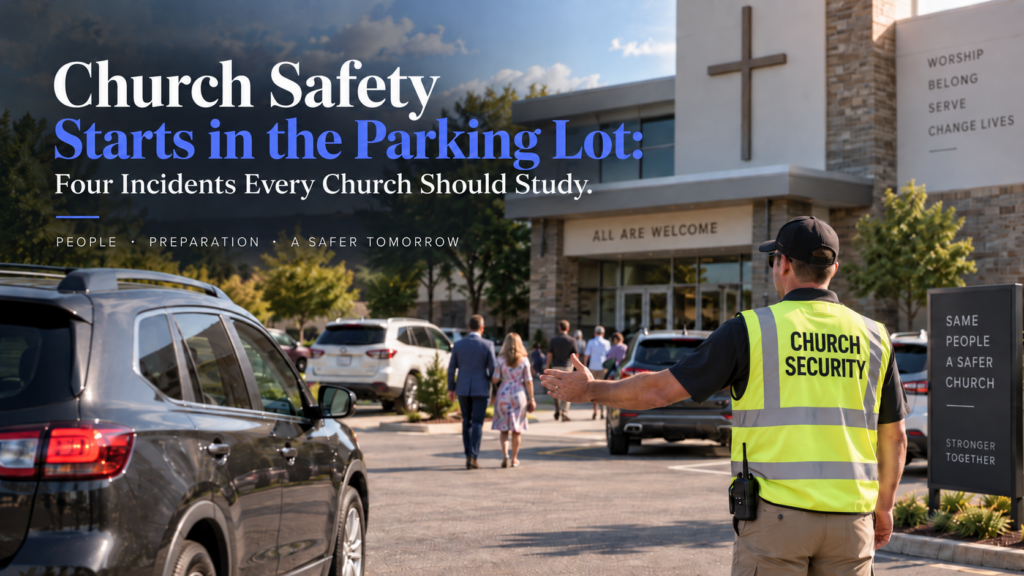
A church parking team has to see the entire environment. That is why I teach four basic responsibilities:
Direct
Help vehicles move through the property safely and predictably.
Protect
Protect pedestrians, families, children, elderly guests, people needing additional assistance, and yourself.
Observe
Know your environment. Understand normal activity. Pay attention when something changes.
Communicate
Report hazards and concerning activity clearly. Communicate facts instead of conclusions and get the appropriate people involved.
Direct. Protect. Observe. Communicate.
That is the mission.
New Online Training: Church Parking Lot Safety & Security
Because parking teams are often overlooked in church safety training, we developed a dedicated Church Parking Lot Safety & Security Online Training Course through Protect His House.
The course goes beyond security threats. It covers the full responsibility of the parking team, including team-member safety, directing traffic, pedestrian protection, children and elderly guests, accessibility, common parking lot hazards, communication, situational awareness, suspicious persons and vehicles, and emergency response.
The course can be purchased individually:
Church Parking Lot Safety & Security Online Training Course
https://phhtraining.com/product/church-parking-lot-safety-security/
It is also included with:
Access Plus
https://phhtraining.com/product/phh-access-membership/
SafeChurch
https://phhtraining.com/product/phh-safechurch/
The purpose is not to turn parking volunteers into security officers. It is to help people perform the role they already have with greater awareness, consistency, confidence, and safety.
Safety Starts Before the Front Door
These four incidents had dramatically different outcomes.
At CrossPointe, unusual driving in the parking lot preceded an armed attack. At Grand Blanc, the attack began with a vehicle being driven into the church. At Wesley Memorial, someone recognized a potential concern in the parking lot and contacted authorities before anyone was injured. At Temple Israel, an attacker remained parked outside for more than two hours before using his vehicle to breach the building.
There is no single tactic that would guarantee prevention in all four cases. That is not how safety works.
What these incidents demonstrate is the value of layers.
Know your property. Train your people. Protect pedestrians. Establish communication. Maintain emergency access. Understand what normal looks like. Recognize changes. And get the right people involved when something does not fit.
The person wearing the reflective vest in the parking lot may look like they have one of the simplest jobs in the church. In reality, they may occupy one of the most important observation points on the entire property.
Because church safety does not begin when someone reaches the sanctuary.
It begins when they enter the property.
Works Cited
Aldridge, Bailey. “Man Shows Up at Church with 2 Flamethrowers, NC Police Say.” The Charlotte Observer, 29 June 2026.
Associated Press. “Deacon Hailed as a Hero after Helping Thwart Michigan Church Shooting Gets a New Pickup Truck.” Associated Press, 10 July 2025.
Federal Bureau of Investigation. “Detroit Special Agent in Charge Jennifer Runyan Delivers Final Update on West Bloomfield Attack.” FBI, 2026.
Federal Bureau of Investigation. “FBI Detroit Update on Shooting and Fire at Grand Blanc LDS Church.” FBI, 30 Sept. 2025.